
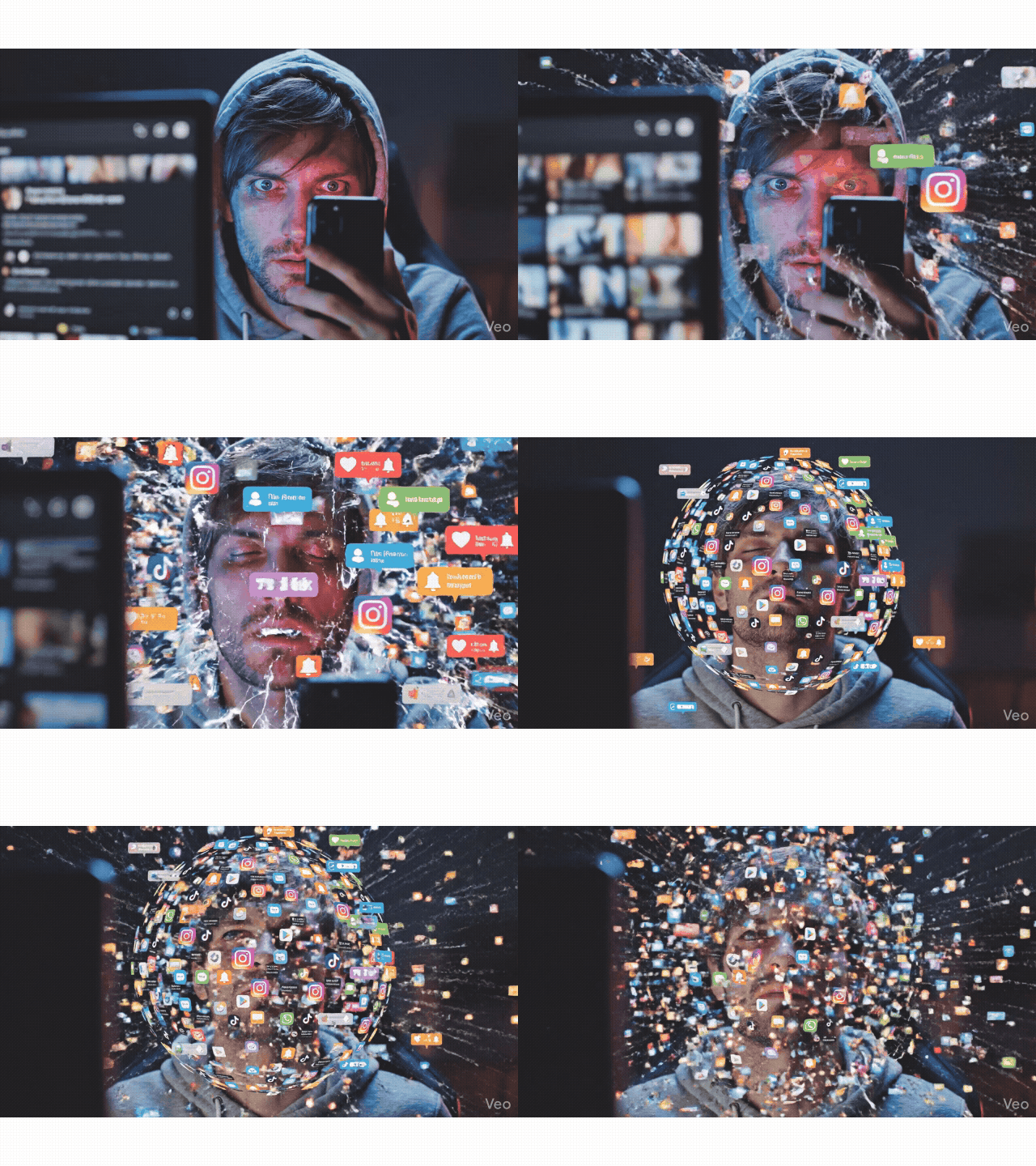
The Attention Span Collapse: What Elite Performers Know That Could Save Us All
In courtrooms across the UK, something is happening. Judges are reporting that juries can no longer concentrate long enough to follow complex evidence. Barristers are being advised to simplify arguments. Our legal system, built on careful deliberation, is buckling under the weight of citizens whose attention has been hijacked.
This isn't just a courtroom problem. This is a civilisation problem. And the press, trapped in the same high-velocity cycle of clicks and impressions, is failing to cover it with the gravity it deserves, despite it being arguably as consequential as climate change.
"The capacity for deep focus and sustained attention is declining. The neural circuits responsible for more deliberate, slower cognitive tasks are actually weakening." This isn't speculation. This is from peer-reviewed research published in PMC's "Brain Rot in the Digital Era.
I delete Instagram from my phone every morning before work and don't redownload it until after 8pm. Even knowing everything I know about attention and focus, I'm still a typical social media victim.
And right now, while you're reading this, millions of young minds are being rewired in ways that may determine the trajectory of human potential for generations to come.
The Doom-Scrolling Generations
"Brain rot" was named Oxford's Word of the Year 2024. It refers to "the supposed deterioration of a person's mental or intellectual state, especially viewed as the result of overconsumption of material considered to be trivial or unchallenging."
Except there's nothing "supposed" about it anymore. The science is in.
A study from Karolinska Institutet tracking 8,324 children found that social media use is directly linked to a gradual decline in the ability to concentrate. This effect was not found with television or video games. It's specifically the endless scroll and the dopamine-driven feedback loops of social media platforms. Now, correlation isn't causation, and you could argue that kids with attention issues gravitate toward social media. But the longitudinal design of the Karolinska study suggests the relationship runs in the other direction: the platforms are shaping the attention, not just attracting those who already struggle.
We have suspected this for over a decade; we are all being played and manipulated by the algos in very highly destructive ways.
Now we come to the new elephant in the room, AI. MIT Media Lab put it starkly: "Over four months, LLM users consistently underperformed at neural, linguistic, and behavioural levels." This is a key distinction: while Generative AI threatens to do our thinking for us, atrophying our cognitive muscles, we must pivot toward technology that serves as a Cognitive Scaffold, rebuilding our ability to think for ourselves.
Question: Do you think the social media and AI companies really care? Or are they happy to let it accelerate, making us forever reliant on their tech and experiences while reducing our cognitive powers?
Full disclosure: I used AI to help refine the structure of this article and to check spelling and grammar, but the ideas and narrative are mine, as is the research legwork. That's the right way to use these tools: as a scaffold for your own thinking, not a replacement for it. I'm still using my critical analysis and deep learning skills to their fullest, so hopefully this reads well.
The Numbers
The research is now undeniable.
This cognitive erosion follows us from the classroom to the boardroom, where the price tag is significant. Distraction is costing the UK economy £19.9 billion annually, according to research from the QEII Centre. Nearly twenty billion pounds lost because we simply cannot focus anymore. And that's just the economic cost. It barely scratches the surface of what's actually happening to us.
Consider what Dr Gloria Mark, Professor of Informatics at University of California Irvine, discovered when she began tracking attention spans in 2004. Using direct observation and computer logging software to track how long people stayed on a single screen before switching, she found the average was two and a half minutes. By 2012, it had dropped to 75 seconds. Today? Her research shows attention spans averaging between 44 and 50 seconds.
We have lost more than two-thirds of our ability to concentrate in just two decades.
And it gets worse: "Shorter attention spans are linked to more errors, longer task completion times, and increased stress." This isn't about productivity metrics or corporate efficiency. This is about what happens when an entire generation loses the capacity for deep thought. We're watching it happen in real time, and most people are too distracted to notice.
The Workplace Cost
If you think this is just about young people on their phones, think again.
Corporate compliance research reveals that 49% of professionals skip-read or don't listen to mandatory compliance training in detail. Nearly half. In a world where regulatory failures can cost billions and destroy companies overnight, we've created a workforce that can no longer absorb critical information. I've spoken to compliance officers who are deeply concerned by this.
Between 2020 and 2024 US businesses faced over 180,000 corporate fines totalling more than $345 billion. How many of these stemmed from employees who simply couldn't maintain the focus needed to do their jobs properly? Nobody's measuring this. They should be.
The QEII research found that 83% of people admit to being distracted during in-person meetings, rising to 85% for online meetings. 38% of workers are actively concerned about their own inability to fully concentrate.
This isn't laziness. This is a generation whose cognitive architecture has been fundamentally altered by the technology we've surrounded ourselves with.
The Neurodiverse Time Bomb
Perhaps nowhere is the attention crisis more acute than in our schools. And this is where it gets personal for me.
In West Yorkshire alone, one local authority identified 10,000 children, approximately 18% of the school population, with Special Educational Needs. The waiting list for autism and ADHD assessment? 7,000 children. Seven thousand kids are waiting for help that may never come.
The research is clear: children with SEN are seven times more likely to be excluded from school than their peers. And exclusion doesn't solve the problem. It amplifies it. Excluded children are four times more likely to end up in prison as adults. We're not just failing these kids educationally. We're failing them as a society.
We are systematically failing an entire generation of minds that simply process information differently, while simultaneously creating environmental conditions that make focus impossible for everyone.
What happens when you put an already struggling child in a classroom designed for neurotypical attention, surrounded by peers whose own concentration has been decimated by social media?
You get a system in crisis. You get teachers burning out. You get families breaking down. You get potential being wasted on an industrial scale.
The Answer Is Within Us
We can come out of this crisis learning smarter than we've ever done.
The same neuroscience that explains how doom scrolling degrades attention also reveals how to rebuild it. The capacity for deep focus isn't destroyed. It's dormant. The neural pathways are still there, waiting to be reactivated.
Elite performers have always understood this intuitively. The slow-is-fast paradox. The flow state where hours feel like minutes and information embeds itself effortlessly into long-term memory. Musicians, athletes, surgeons, chess grandmasters: they don't just perform in the zone, they LEARN IN THE ZONE.
And that state isn't genetic. It isn't reserved for the talented few. It's a trainable cognitive condition that's been gatekept by circumstance, not biology.
What if we could democratise it?
The Flow State Solution
Nearly 30,000 hours of guitar practice, touring with artists like Nigel Kennedy, Brian May, Alice Cooper, and Def Leppard, taught me something: That learning in the zone is absolutely crucial to success.
Every musician knows this intuitively. When you're practising properly, when you're really locked in, time disappears. Hours feel like minutes. Information flows in and sticks. This isn't mystical. It's a measurable cognitive state called flow, where the brain operates at peak efficiency.
Cambridge University's Mind Lab research found that briefly tuning into a person's individual alpha wave frequency before learning boosts the speed of skill acquisition by more than three times. Alpha waves create the calm, receptive state; low beta waves drive the focused processing where deep learning happens.
Not 10% faster. Not 50% faster. Three times faster, with solid next-day retention. The science is catching up to what elite performers have always known.
This isn't new science dressed up as innovation. Babies naturally slow their processing to manage the cognitive overload of new information. Behavioural optometrists have used metronomes for decades to help patients with eye tracking issues read better and focus. What's new is our ability to personalise and scale it.
The neural mechanisms are well understood. When we achieve flow, we experience optimal arousal. We're challenged enough to stay engaged, but not so overwhelmed that we shut down. In this state, neuroplasticity increases. Learning deepens. Information actually sticks.
But flow state isn't just about learning. Research consistently shows it reduces anxiety, lowers stress hormones, and improves overall mental well-being. It's a cognitive state that heals as it teaches.
The tragedy is that until now, access to flow state learning has been the preserve of the privileged. Those with private tutors, elite training, or the natural advantages that come with certain neurological profiles. What if we could democratise this? What if every child, regardless of socioeconomic background, could access the same cognitive advantages that elite performers take for granted?
This is the question that drove me to build Tempo Reading.
While doom scrolling weakens neural connections, flow state strengthens them. This is what Tempo Reading was built on.
Fighting Back: Neurocognitive Entrainment
When I founded Tempo Reading, I wasn't trying to build another EdTech app. The EdTech sector is littered with solutions looking for problems. I was trying to solve something fundamental: how do you help anyone, neurotypical or neurodiverse, access the focused learning states that elite performers use instinctively?
The answer lies in the combination of metacognition and neurocognitive entrainment. Metacognition, the awareness and understanding of your own thought processes, is what elite performers develop over years of deliberate practice. Neurocognitive entrainment is the process of synchronising information delivery with the brain's natural rhythms to induce heightened cognitive states. Combine them, and you can shortcut the 30 to 90 minutes it typically takes to achieve flow state, getting learners into deep focus in under 60 seconds.
The technology we built helps identify each student's Optimum Learning Speed in the late alpha early beta wave area, then uses eye-tracking and AI to monitor and track progress, and if you get distracted, it prompts you back. It tracks engagement. It verifies that learning actually happened.
The results from our pilot at Banff Academy, a school where 60% of students require additional support. This was a cohort of 70 students across multiple year groups:
-
97% reported improved focus
-
100% success rate with neurodiverse learners
-
Teachers reported reduced anxiety and increased enjoyment across all students
I know those percentages look too clean. We were surprised too. But that's what the data showed, and it's been consistent across our subsequent pilots with over 1,200 students.
As Deputy Head Teacher Nick Mochan put it: "Tempo has proven effective in reducing anxiety, enhancing focus, and increasing pupil enjoyment, including for those who are neurodiverse, have ASN, or are EAL."
This isn't about making children read faster. It's about teaching their brains to focus deeply again, rebuilding the neural circuitry that doom-scrolling has degraded.
The Stakes Could Not Be Higher
Put simply: the attention span collapse is the cognitive equivalent of climate change. Both are existential threats that emerge gradually. Both are caused by systems designed for short-term gain. Both require collective action before we pass the point of no return.
At Columbia University, literature professors report that students now arrive bewildered by the thought of reading multiple books per semester. One student told her professor she had never been asked to read a full book in high school. This isn't about literacy in the traditional sense. These students can decode words. What they've lost is the capacity to attend to something for an extended period. Professors across America's elite institutions are now reducing reading lists and assigning excerpts rather than complete texts, essentially lowering standards to accommodate cognitive decline. If this is happening at the Ivy League, what's happening everywhere else?
There's another dimension to this crisis that policymakers are only beginning to grasp. Across the G20, populations are ageing rapidly. The OECD warns that without swift changes, GDP per capita growth will slow significantly in most developed economies. The solution everyone points to? Keep people working longer.
But here's the problem: cognitive decline accelerates with age, and we're now entering an era where workers of all ages are experiencing attention degradation from digital overload. We need people to remain cognitively sharp into their sixties and seventies, yet we're building an information environment that's degrading cognitive function across all age groups. The maths doesn't work.
And like climate change, we are practising a kind of wilful blindness. We see our children glued to screens. We feel our own concentration fragmenting. We watch productivity decline and anxiety rise. But we look the other way because the alternative, confronting what we've allowed to happen to human cognition, feels overwhelming. It's easier to blame individuals for lacking discipline than to admit we've built systems that are systematically degrading human potential.
Wilful blindness is no longer an option. Not for parents. Not for educators. Not for employers. Not for policymakers. The data is in. The consequences are clear. The time to act is now.
We are raising a generation that may lack the cognitive capacity to read a scientific paper, follow a legal argument, complete a complex task, or engage in the kind of sustained thinking that every previous advancement in human civilisation has required.
But there's hope. If we act now.
What if we could all focus like Serena Williams, Einstein, Magnus Carlsen? What would be the collective impact? It's almost crazy to think about, and of course, that's an impossible scenario. But if we can recover and then improve our attention spans and capacity for deep learning, the benefits could be enormous.
What We Can Do
For Educators: Stop accepting distraction as inevitable. Tools exist that can actively rebuild focus rather than simply accommodate its loss. The evidence base is growing.
For Parents: Monitor screen time, make sure it is the right screen time. But more importantly, understand that passive consumption of short-form content is actively restructuring your child's brain. The research is detailed: it's not all screen time that's the problem, it's specifically the endless scroll of social media.
For Employers: That £19.9 billion annual cost to the UK economy isn't an abstract statistic. It's coming out of your bottom line. Invest in solutions that restore cognitive capacity rather than merely managing around its decline.
For All of Us: Recognise this crisis for what it is. The attention economy has declared war on the human mind, and right now, the attention economy is winning.
The Choice Before Us
We stand at a fork in the road. In my opinion, this is one of the most important decisions our society will make in the next decade.
One path leads to a future where deep focus becomes a rare and valuable skill, possessed only by those with the resources or luck to escape the attention trap. A world of surface-level thinking and diminished human potential.
The other path requires us to fight back.
To deploy technology in service of human flourishing rather than engagement metrics. To restore the capacity for sustained attention that is the foundation of everything we value: creativity, learning, justice, democracy itself.
The societal implications are huge. When every child, not just those with access to elite resources, can learn in flow state, we don't just improve individual outcomes. We level a playing field that has been tilted against disadvantaged communities for far too long. We reduce the anxiety and mental health burden on young people. We rebuild the cognitive infrastructure that democracy, innovation, and human flourishing depend upon.
Did you get to the end without checking your phone?
Tim Wilson is CEO and Founder of Tempo Reading, an educational technology company using eye-tracking and neurocognitive entrainment to help learners access flow state. A law degree equipped former professional musician with nearly 30,000 hours of deliberate guitar practice; he toured in support bands alongside Brian May, Alice Cooper, Def Leppard, and even Wheatus of Teenage Dirtbag fame. He combines deep expertise in elite performance and metacognitive learning with ten years of assisted AI consumer innovation.
Learn more at temporeading.com | Connect on LinkedIn | Tim@temporeading.com
Sources:
The Attention Crisis No One Is Connecting: This takes 10 minutes to read. The average attention span is now 47 seconds. Let's see how you do.
Tim Wilson, CEO Tempo Reading / 13th Jan 2026